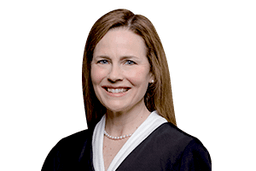
Amy Coney Barrett
Associate Justice of the Supreme Court of the United States · Appointed by Donald J. Trump
Voting Record
Total Votes
50
In Majority
92%
Dissents
4
Ideology
+0.5 Con
Recent Votes
Ellingburg v. United States
24-482 · 2025 Term
Chevron USA Inc. v. Plaquemines Parish, Louisiana
24-813 · 2025 Term
Rutherford v. United States
24-820 · 2025 Term
Landor v. Louisiana Department of Corrections
23-1197 · 2025 Term
Federal Communications Commission v. AT&T, Inc.
25-406 · 2025 Term
Rico v. United States
24-1056 · 2025 Term
Blanche v. Lau
25-429 · 2025 Term
Pitchford v. Cain
24-7351 · 2025 Term
T. M. v. University of Maryland Medical System Corporation
25-197 · 2025 Term
Cisco Systems, Inc. v. Doe I
24-856 · 2025 Term
M & K Employee Solutions, LLC v. Trustees of the IAM National Pension Fund
23-1209 · 2025 Term
E.M.D. Sales, Inc. v. Carrera
23-217 · 2024 Term
Urias-Orellana v. Bondi
24-777 · 2025 Term
Flowers Foods, Inc. v. Brock
24-935 · 2025 Term
Wisconsin Bell, Inc. cv. United States, ex rel. Heath
23-1127 · 2024 Term
Stanley v. City of Sanford, Florida
23-997 · 2024 Term
Diamond Alternative Energy LLC v. Environmental Protection Agency
24-7 · 2024 Term
Esteras v. United States
23-7483 · 2024 Term
Montgomery v. Caribe Transport II, LLC
24-1238 · 2025 Term
Exxon Mobil Corp. v. Corporación Cimex, S.A. (Cuba)
24-699 · 2025 Term
Financial Disclosures
Gifts, paid travel, and outside income reported by this justice. Data sourced from CourtListener (Free Law Project).
No financial disclosure data synced yet. Run the sync-scotus cron job to import data from CourtListener.
Biography
Amy Coney Barrett was a law professor at Notre Dame when President Donald J. Trump nominated her to the U.S. Court of Appeals for the Seventh Circuit in 2017. She served as a federal appeals judge for three years before being confirmed as a U.S. Supreme Court Justice in October 2020.
Born Amy Vivian Coney in New Orleans, Louisiana, Barrett was the oldest of seven children. Her father, Mike, was an attorney for Shell Oil, and her mother, Linda, was a French teacher. Barrett grew up in Old Metairie, where she attended St. Catherine of Siena for elementary school and went on to St. Mary's Dominican High School. She attended Rhodes College in Memphis, Tennessee, where she graduated magna cum laude with a B.A. in English literature. She then went on to attend law school at Notre Dame, where she graduated summa cum laude.
After law school, Barrett was a judicial clerk for Judge Laurence Silberman of the D.C. Circuit and then for Supreme Court Justice Antonin Scalia. In 1999, after her clerkship with Justice Scalia ended, Barrett worked at the D.C. law firm of Miller, Cassidy, Larroca & Lewin.
In 2001, Barrett accepted a position as the John M. Olin Fellow at Law at George Washington University Law School. In 2002, she returned to her alma mater as an assistant professor of law. As a professor at Notre Dame, she became known as an expert on federal courts, constitutional law, and statutory interpretation. She also gained recognition as a staunchly conservative Catholic. In 2012, she signed a statement criticizing President Barack Obama's Affordable Care Act (ACA) for its contraceptive mandate.
In May 2017, President Trump nominated Barrett to the Seventh Circuit, and she was confirmed in October 2017 by a vote of 55-43. Democrats at her confirmation hearings expressed concern that she would be unduly influenced by her religious beliefs. A list of opinions Judge Barrett authored while a judge on the Seventh Circuit is available from Justia.
On September 26, 2020—one week after Justice Ruth Bader Ginsburg died and on the eve of the 2020 Presidential Election—President Trump nominated Barrett to the Supreme Court to fill Justice Ginsburg's seat. Her selection was extremely contentious, due in large part to the hypocritical push by Senate Majority Leader Mitch McConnell to confirm her just before the election despite refusing to hold a hearing four years earlier on President Obama's Supreme Court nominee, Merrick Garland.
On October 22, 2020, the Senate Judiciary Committee voted unanimously (with the Democrats boycotting the vote) to advance Barrett's nomination, and on October 26, the Senate confirmed her by a 52-48 vote. She was sworn in by Justice Clarence Thomas.